The Principle of Hell: “I Am My Own”
Surprised by JoyThe Principle of Hell: “I Am My Own” is C. S. Lewis’s name for the self-enclosed claim that no one—not even God—has a right to make demands on the self. First stated as a declaration of private ownership, it becomes the governing principle of his resistance to Christianity and the sharpest contrast to the surrender he eventually describes as liberation. The phrase links his youthful hatred of authority to the moment when the God he had treated as an idea becomes an unavoidable presence.
The demand for a private territory
In his account of his earlier outlook, Lewis locates the principle in a profound hatred of authority. No word in his vocabulary expressed deeper hatred than “Interference”; Christianity seemed to place at its center a “transcendental Interférer.” If its picture of reality were true, he believed, no treaty with reality could be made and no inner territory could be kept beyond its reach. His wish was for some area, however small, that he could call his business alone.
This desire was connected to his temperament and his history. The period of faith he had experienced at Oldie’s had contained fear, and in retrospect he magnified that fear while forgetting other elements of the experience. He dreaded a return to the full-moonlit nights in the dormitory. More broadly, he was more eager to escape pain than to attain happiness, and resented having been created without his permission. The prospect of a universe without the Christian God therefore seemed to offer relief from an authority that could claim the whole of him.
His preference for materialism was not, in his retrospective judgment, simply an argument freely chosen on neutral grounds. He acknowledges that materialism looked especially probable partly because it favored one of his wishes: it promised limited liabilities. Death would end everything, and, if finite disasters became unbearable, suicide remained imaginable. Christianity, by contrast, seemed to have no exit. Yet this attraction came at a price he says he tried to pay honestly: the universe had to be understood as a meaningless dance of atoms, beauty as subjective phosphorescence, and whatever he valued as a mirage. What he gained was not a positive account of human purpose but the negative promise that no infinite claim could reach him.
From wish to principle
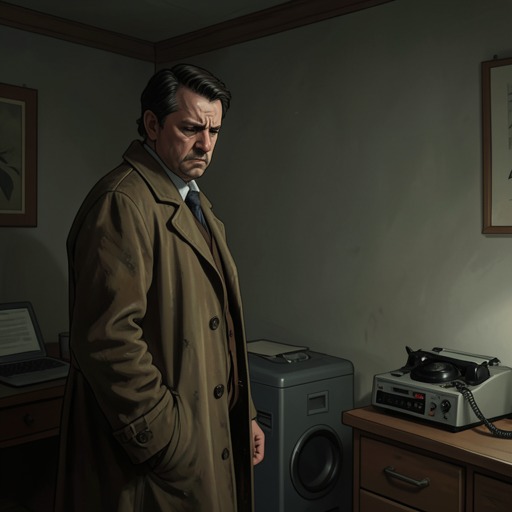
The phrase “I am my own” gives this wish its starkest form. Lewis’s image is not merely of a person preferring independence in ordinary affairs, but of a soul enclosed by a boundary and guarded against every other being. He describes wanting to surround the innermost depth of the self with barbed wire and a “No Admittance” notice. The imagined boundary is absolute: it is meant to reserve a place that no authority can enter or command.
That boundary also exposes a contradiction in his position. Lewis admits that he may have been guilty of wishful thinking in finding materialism so persuasive, since it served his desire to remain untouched. But he resists reducing his thought entirely to that desire: on large questions, he argues, every conception of reality gratifies some wishes and frustrates others. Materialism did not spare him the cost of accepting a meaningless universe. His effort to accept that cost loyally was shaped, he says, by what he had learned from Kirk about intellectual honor and the shame of voluntary inconsistency. Even so, he recalls displaying a youthful, vulgar pride in his supposed enlightenment and arguing with Arthur in a crude, swaggering manner. The principle therefore describes more than a doctrine; it names the private sovereignty that made the doctrine so attractive.
The principle tested by God
By the time Lewis describes his eventual surrender, the wish to be left alone has acquired its full theological weight. He recalls that he had always wanted not to be interfered with, to call his soul his own, and to keep his liabilities limited. Even his attempt to live by his philosophy had, he now recognized, been ringed with reservations: he expected that his ideal of virtue would never lead him into anything intolerably painful and assumed that he could remain “reasonable” in the comfortable sense of the word.
The decisive change came when an abstract philosophical possibility became a living presence. Lewis recounts that the Adversary did not debate whether his admitted “Spirit” differed from the God of popular religion; that distinction sank into unimportance. The words that confronted him were “I am the Lord”; “I am that I am”; “I am.” What had been something he could consider as a theorem now made a claim on him. The opposition between private self-possession and divine authority was no longer safely theoretical.
Lewis distinguishes this demand from the earlier, more gradual movement toward belief. He says the stage of an “All or nothing” choice had already passed, and recalls the moment on a bus top when he unbuckled his armor and the snowman began to melt. Now, he says, the demand was simply “All.” The formulation strips away the compromise the principle had tried to preserve: no small inner region could be fenced off, and no treaty could limit what reality might ask.
Surrender and reversal
In Trinity Term 1929, alone in his room at Magdalen night after night, Lewis felt the steady approach of the God he earnestly did not wish to meet. He describes the experience as the arrival of what he had most feared. He gave in, admitted that God was God, knelt, and prayed. He later calls himself perhaps the most dejected and reluctant convert in England, emphasizing that the act was not the comfortable fulfillment of a wish to believe.
The reversal changes the meaning of the principle. Lewis did not then see what he later regarded as the clearest fact: that divine humility accepts even a resentful convert. He contrasts the Prodigal Son, who at least walked home on his own feet, with the prodigal brought in kicking, struggling, resentful, and looking for a chance to escape. Against the human abuse of the words “compel them to come in,” he interprets compulsion as an expression of divine mercy. The account ends by turning the apparent opposition between authority and freedom inside out: “The hardness of God is kinder than the softness of men, and His compulsion is our liberation.”
The principle thus serves as both diagnosis and foil. It gathers Lewis’s fear of suffering, resistance to authority, and longing for a protected inner domain into a single declaration; the conversion narrative then tests that declaration against a reality he cannot keep at a distance. What had appeared to him as freedom—the right to belong to himself alone—is exposed as an attempt to reserve judgment over every claim. In the ending Lewis presents surrender not as the preservation of that sovereignty, but as release from its limits.